The University of Western Australia
School of Computer Science and Software Engineering


School of Computer Science and Software Engineering

4th Year Studies In Computer Science

The research project is a year-long unit that introduces you to scientific research. The purpose of the research project is to provide you with the opportunity to study a topic of interest in some depth and to develop scholarly skills towards research techniques. It is expected that by the end of the year, you will have read widely in your area, extended or developed some theoretical work, have implemented some existing work, or possibly have even extended some implementation. Most importantly, you must demonstrate that you have developed the appropriate skills to communicate your work and ideas, in each of a written dissertation, a seminar, a software demonstration (where appropriate), and a poster.

The research project must be completed over two consecutive semesters. The point value of the research project depends on the the degree the student is enrolled in: 24 points for end-on honours courses (BCM, BCompSci, and BSc), and 12 points for the 4th year Bachelor of Engineering (Software Engineering) course. More information on which actual research project unit must be selected can be found on the units page.

Information on how the research project is assessed can be found on the project assessment page.

Information about important dates governing the research project can be found on the important dates page.

Types of projects

Naturally, projects vary enormously, but fit broadly into one of the following categories:

  • A constructive project will be judged according to its usefulness, specification simplicity, computational complexity, and its degree of innovation. A construction in Computer Science includes useful computational notions, abstract construction, semantic representation, innovative data structures, algorithms, and system design. You must demonstrate by formal or informal argument, and by executable code, the salient features of the new construction as well as justifications for your design.

  • An experimental project will be judged as such. For example, if you write some code that supposedly understands English language sentences, then you should conduct a wide range of experiments, showing where your software both succeeds and fails. Moreover, it is important that you define clearly the scope of the data it is meant to handle (in this case, what type of sentences, which dictionary of words, etc.).

  • A theoretical project will typically include theorems which must be rigorously proved, axioms stated clearly, and definitions clearly set out.

  • A review project will be expected to display a thorough degree of scholarship. The literature must be fully researched and the dissertation should show that you have been capable of criticising and synthesizing ideas to give a global view of the area. The bibliography must be extensive.

Choosing a project

You must select a project to work on during the year. You may either propose own your project or select a project from a list of pre-designed projects, but either way, it is your responsibility to find a project supervisor within the School to agree to supervise the project. That is, you will need to find a supervisor yourself; you will not be allocated one.

Student ideas for projects will only be accepted if the project contains enough academic content and a suitable project supervisor can be found to supervise the project. Project ideas can be submitted either directly to any academic in the School, or directly to the 4th Year Coordinator. You should speak to potential supervisors to discuss the scope of a project to see if your idea can be adapted to the requirements of their specific degree.

On the forementioned list of pre-designed projects, you will find short biographies for many of the School's academic staff and the 4th year projects that they are hoping to supervise in the coming year. Study this list thoroughly, remembering as you do that the list of projects is far from exhaustive, and that most staff are willing to hear and discuss your suggestions for other possible projects. You may do a project on almost any topic not on the project list, as long as there is an academic staff member willing to supervise you. If you have any ideas, do not hesitate to approach relevant staff members about them. Projects involving specialised equipment, such as computer-vision cameras or external computing equipment, may require special approval.

You may not be able to work on your preferred project. Supervisors usually restrict the number of 4th year projects they are willing to supervise. Roughly speaking, three or four projects per supervisor is a reasonable limit. This is for your benefit as supervisors have a fixed amount of time that they can devote to each student.

Dissertation

The culmination of the research project takes the form of a research dissertation, an approximately 50 page document that details what you have learned during the course of your studies. Information about how the dissertation is assessed can be found on the project assessment page. A template for constructing a dissertation is available from dissertation template page.

Meeting with your supervisor

You are expected to meet with your supervisor regularly (at least once a fortnight is typical). The length of these meetings will vary according to your needs, but it is important that you attend even if it is to say there are no current problems. If two or more of you are working in closely related areas, even if not with the same supervisors, it may be helpful for you all to meet at once to discuss your ideas and problems with a bigger audience.

Research groups

Your project supervisor will be a member of at least one of our School's research groups. Other members of each group will also be able to provide valuable knowledge and interaction. You are encouraged to participate and contribute to your research group, typically by attending any meetings and discussions they hold. Make the most of the members of your research group - they will be able to provide you with valuable assistance and knowledge about your project.

Seminars

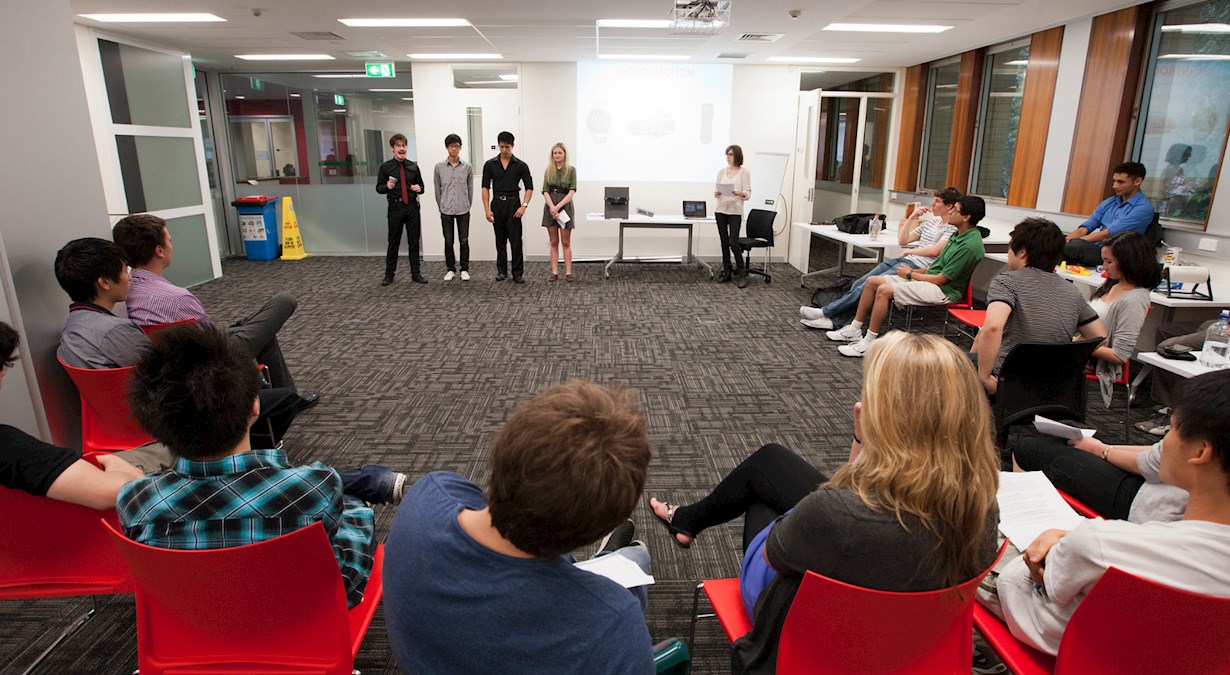
Most researchers in the field of Computer Science communicate their results through seminars or conference proceedings. School seminars will be held (usually) weekly at 11:00am on Fridays during semester. Upcoming seminars are listed on the seminar programme web-page. Speakers are normally from outside the School and give presentations on a wide range of interesting subjects, some not covered during your course. These seminars are considered to be part of your 4th year programme and your attendance is required unless you have a good reason not to be there. It should be recalled that you will have to deliver a seminar yourself at the end of your project and as such it is in your own interest to attend as many seminars as possible.


School of Computer Science and Software Engineering

This Page

Last updated:
Mon Mar 5 12:49:33 2012

Website Feedback:
wei@csse.uwa.edu.au

http://undergraduate.csse.uwa.edu.au/year4/Current/